Showing posts with label PLAYERS. Show all posts

11/29/2006

INTRODUCING VISWANATHAN ANAND

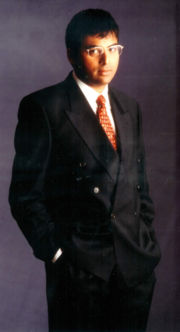
Viswanathan Anand was born in India in 1969. As we will see, it may be said decades later that Anand was one of the most important figures in chess history, and not just for his own play. He shot to success as a junior, crushing all competition he faced in India, becoming an International Master at 15, and then becoming Indian Champion at 16.

In 1987, "Vishy" became World Junior Champion, the first person from India ever to accomplish this. The next year, in 1988, he became an International Grandmaster, also the first in India's history. Not only that, he was only the second person from South Asia to earn this highest accolade (the first was Niaz Murshed from Bangladesh, a year earlier).

Anand earned the nickname "Lightning Kid" because he played his games—even the most important of games—at a pace that others would use for blitz chess! His vision and calculating abilities are legendary.

After becoming a Grandmaster, Anand continued to excel in big-time events, winning the 1991 Reggio Emilia supertournament ahead of both Kasparov and Karpov! He began competing in the World Championship cycle, engaging in something of a duel with Gata Kamsky as they played two big matches. Because of the split in the chess world that took place in 1993, two World Championship cycles were running at the same time, the FIDE cycle, and the Kasparov-led PCA cycle. Anand and Kamsky made it to the Candidates Final of both cycles—Kamsky previaled in the FIDE match and won the right to challenge Anatoly Karpov in 1996 (he lost 10.5-7.5), while Anand prevailed in the PCA match, and won the right to challenge Garry Kasparov in the 1995 PCA World Championship Match.

This match was held in New York City's World Trade Center, with the match commencing on September 11. Anand was certainly the underdog, but in the mid-1990s it may be that Kasparov showed the most vulnerability of his career (for whatever reason), as he did not dominate quite as much as he did before or after. Anand was rising fast...could he win?

Alas, it was not to be. Kasparov and Anand drew the first eight games of the match. This suited Kasparov fine, because in the case of a 10-10 tie, he would keep his title. Anand then won Game 9 in spectacular fashion, culminating in a very strong exchange sacrifice (27.Rd5!!). However, Kasparov came back with a devastating blow in the famous Game 10: using 24 hours of preparation by himself and his team from the seeds of an idea spawned circa 1978, Kasparov came up with a briliant rook sacrifice to gain a winning position. While Kasparov won that game, it is noteworthy that Anand (though he used 50 minutes to find a way out of the worst of it, in contrast to his usual rate of play) was able to fashion a defense, and send the game to an endgame. A survey of the minefield of pitfalls he could have fallen into shows how much Anand sees at the board, and could be considered (in this era of computer-aided preparation, etc.) one of the greatest over-the-board defensive efforts in modern times.

Kasparov went on to win Games 11, 13, and 14 (in this game Anand had a nearly winning position) before the last four games were drawn to conclude the match. Kasparov kept his title 10.5-7.5.

Anand recovered from this setback, however, and continued to be ranked in the World Top 3, playing extremely well and winning supertournaments. In his career, he has won the prestigious tournaments Dortmund (2004), as well as three Corus tournaments, and several Melody Amber events. He has won multiple Advanced Chess events (where players use the help of computers), as well as multiple World Rapid Championships.

In 2000, in his home country of India, Viswanathan Anand became the FIDE World Champion, having defeated Alexei Shirov in the final 3.5-0.5. He was the last man standing in a field of 128 players.

In India, Anand is the most popular sportsman and, indeed, was named India's Sportsman of the 20th century. His influence on Indian Chess is perhaps greater than that any player has ever had on chess in a country in decades: India is now one of the very best chess countries in the world, with several young and strong Grandmasters, hosting more events, all because of Anand's success.

To see a biography of Viswanathan Anand on Wikipedia, click here.

To see Viswananthan Anand's games on ChessGames.com, click here.

11/27/2006

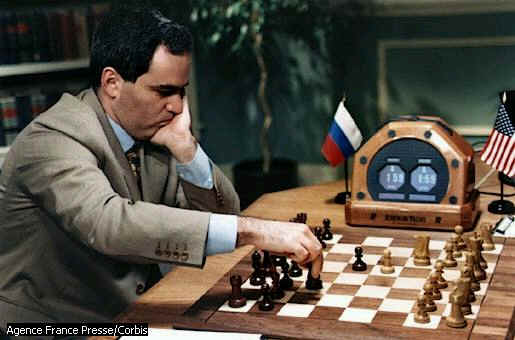
INTRODUCING GARRY KASPAROV

Garry Kasparov was born in Baku, Azerbaijan in 1963. In contrast to his future eternal rival Anatoly Karpov, former World Champion Mikhail Botvinnik said upon seeing Garry's analytical abilities as a child, "this boy is a genius...I will work with him individually." Personally trained by the patriarch of the Soviet School, the man who is credited for professionalizing chess study, being touted as a future World Champion before his teen years...all of this had meant enormous expectations of greatness for Kasparov. Enormous expectations...which he was ultimately able to meet!

Kasparov is one of those players whose rise to the top of the chess world featured a successful scaling of every peak placed in front of him, without any real setbacks until he became one of the very best players in the world. In this way, his career is reminiscent of that of all-time greats such as Paul Morphy, Akiba Rubinstein, Jose Capablanca, and Bobby Fischer. Kasparov became a master after winning the Sokolsky Memorial tournament in Minsk (now the capital of Belarus) in 1978. This convinced Kasparov that he should become a chess professional and, indeed, that he could become the World Champion! After a strong performance in the Banja Luka tournament of 1979, Garry Kasparov's provisional rating was an incomprehensible 2595! For a player to debut on the FIDE rating list as a supergrandmaster-level player is unprecedented. It simply showed how frighteningly strong Kasparov was as a teen.

It came as no surprise, then, that Kasparov won the 1980 World Junior Championship, becoming an International Grandmaster in the process, at the age of 17. With the slew of 13- and 14-year old Grandmasters being grown nowadays, it should be said that Kasparov was probably already a Top-10 player when he acheived the title—the youngsters of today usually take years to reach such a level after becoming a very young GM, if they ever do. Maybe the only other comparable examples are Fischer, who became a GM at 15 in 1958 (at that time he was certainly a Top-10 player as well, but it took him some years still to challenge for the World Championship), and Ruslan Ponomariov, who became a GM at 14 in 1998 and upset Vassily Ivanchuk to become FIDE World Champion in 2002.

The Chess World already knew who would be Anatoly Karpov's next challenger for the Crown—and Karpov knew it too. Viktor Korchnoi, who had fought Tolya in 1974, 1978, and 1981 appeared to be weakening very slightly. Kasparov fought his way through the next cycle—he defeated Alexander Beliavsky, Viktor Korchnoi, and the 63-year-old ex-World Champion Vasily Smyslov in the Candidates' Final to face Karpov in the 1984 World Championship Match.

The match was stipulated to be won by the first player to win 6 games. Karpov jumped out to a commanding lead—4-0 after only 9 games! It looked as if the young gun from Baku had finally met his match and was about to be unceremoniously blown away. However, Kasparov decided to play to draw—he drew the next 17 games before losing again to find himself in an 0-5 hole. One more loss would mean the end of the match, and a shutout at that. More draws followed until Kasparov won for the first time in Game 32—Vladmir Kramnik has said that one cannot fully comprehend Karpov until he begins to play with him, and it may be that at this point Kasparov had adjusted to the Champion's exasperating style.

Up 5-1, Karpov just could not shut the door. More draws followed after Game 32 until Kasparov broke through and won games 47 and 48. It was at this point that the FIDE President Florencio Campomanes stopped the match because of Karpov's exhaustion. The final score was 5-3. Karpov retained his title, but a rematch was scheduled for the next year, in 1985. This match would be best-of-24, draws counting this time. Karpov would retain the title with a score of 12-12 or better, while Kasparov required at least 12.5 points to become the Champion.

With Karpov down 11-12 heading into the final Game 24, the Champ could not find enough to keep the title. Kasparov actually won the last game, to win the title by a final score of 13-11. At 22 years old, he became the youngest World Champion ever; Tal was laureled at the age of 23 in 1960.

13 points to become the 13th World Champion, for the man born on April 13th. Indeed, Kasparov has said that 13 is his lucky number!

Kasparov defended his title three times against Karpov—in 1986 (12.5-11.5), 1987 (12-12; Karpov blundered in Game 24 when a draw would have given him the title again!), and 1990 (12.5-11.5).

Kasparov's next challenger in the 1993 World Championship cycle was the Englishman Nigel Short, who knocked out Karpov in the Candidates Semi-Final en-route to the showdown. This is when the chess world split, a schism only repaired in October 2006 with the reunification of the titles, as Kasparov and Short wanted more money for their match, and broke away from FIDE to form the Professional Chess Association (PCA). Karpov became the FIDE Champion again, while Kasparov embarrassed Short 6-1 with 13 draws.

Kasparov then defended his PCA title against Indian superstar Viswanathan Anand in 1995. This match was held in a spectacular venue—107th floor of the World Trade Center in New York City. The match began on September 11. Kasparov won it 4-1 with 13 draws.

The PCA fell apart, and Kasparov tried to get funding for a new organization: the World Chess Council (WCC). He was to challenge the winner of the WCC Candidates Match held in Cazorla, Spain in 1998 between Vladimir Kramnik and Alexei Shirov. Shirov won 2-0 with 7 draws, but the match with Kasparov fell through. Shirov claims he was never paid for the match.

Kasparov's next World Championship Match would be his last: against Vladimir Kramnik in London in 2000, this time under the auspices of BrainGames Network (BGN). Although Shirov defeated Kramnik in 1998, Kramnik somehow got the chance to face Kasparov. Kramnik won 2-0 with 13 draws to end Kasparov's long title reign.

Kasparov dominated chess since his rise to the top until his retirement in 2005. He won more supertournaments than any other player and was continuously ranked #1 on the rating list. His highest-ever rating was a record 2851 in July 1999. The former Champion now focuses on Russian politics and sometimes provides commentary for newspapers and for chess tournaments. He is the author the highly-acclaimed, five-part series of books My Great Predecessors about past World Champions and other great players of the Champions' eras.

To see a biography of Garry Kasparov, click here.

To see Garry Kasparov's games on ChessGames.com, click here.

INTRODUCING SUSAN POLGAR

Susan Polgar was born in 1969 and is the oldest of the three Polgar sisters, the famous Hungarian trio that changed gender perceptions in chess forever. Through training from their father and chess author Laszlo, and years of impressive tournament performances, they proved beyond a shadow of a doubt that females can compete with males in chess.

By her teen years, Susan had already become the highest-rated female chessplayer in the world, in 1984. The Woman World #1 ranking was taken from her in 1986 when, in an unfair and unprecedented decision, FIDE (the International Chess Federation) decided to award every single woman chessplayer in the world an additional 100 rating points—except Polgar. The official reasoning was that Polgar competed mostly in mens' tournaments, unlike the other women on the rating list. Many believe, however, the USSR pressured FIDE to take this decision because the Soviet Union did not want a non-Soviet at the top of the rating list. Indeed, until Susan (and later her sister Judit) began their rise to the top, a Soviet woman had been at the top.

Despite such adversity, Susan continued to compete in mens' tournaments, and very successfully. The ultimate proof came in January, 1991: Susan Polgar became the first woman in history to earn the "Mens" Grandmaster title (GM). The Womens Grandmaster (WGM) title requires a considerably lesser level of play; two past Women's World Champions—Nona Gaprindashvili and Maia Chiburdanidze-had indeed become "Mens" Grandmasters first, but they were awarded the title automatically by virtue of becoming Women's World Champion, and not through tournament play.

Today, Susan Polgar says that in this way she was the first woman to break the "gender barrier" in chess, and there is much truth in this. Today, there are only 11 women total who hold the GM title in the world. There are over 700 Grandmasters in the world.

In Jaen, Spain in 1996, Susan herself became the Women's World Champion by defeating another very strong female player, Xie Jun of China, in a match. During this match, its wealthy sponsor Luis Rentero sent critical letters to both players because they made two short draws at one point. The PCA World Championshp Match between Garry Kasparov and Viswanathan Anand, held the previous year in New York, opened with eight straight draws and saw a total of 13 draws in 18 games!

Xie Jun fought her way back for a chance at a rematch against Polgar in 1999. But FIDE, which has a spotty (at best!) history of organizing smooth World Championship matches, could not reach an agreement with Polgar for the match because the Champion demanded recovery time from the birth of her first child which FIDE did not grant, and because FIDE proposed to hold the entire match in China, the Challenger's home country. That is a definite no-no in World Championship match organization!

The result was that FIDE would end up stripping yet another Champion of their title: Bobby Fischer in 1975, Garry Kasparov in 1993, Susan Polgar in 1999 and, at the end of that year, FIDE would also strip Anatoly Karpov of his FIDE title for his refusal to play! Susan later sued FIDE and won damages in court.

Despite not having the World Champion's title anymore, Susan is still the second-strongest women player in the world (ever?), to her sister Judit who is in the World's Top 10 Overall.

Great players in chess history have also been measured, in part, by their performance in team events. In the Women's Olympiads, Susan has been frightening to face, winning 10 Medals so far, individual and team, including 5 Golds. She led the US Women's Olympiad team to its first-ever medal (Silver) at Calvia (Spain), 2004 while posting by far the best individual result in the entire competition.

Now living in New York, Susan has opened the Polgar Chess Center and is also an active organizer in youth and female scholastic events. One of the most visible faces of the USCF these days, she has no doubt increased the popularity of chess in the United States, especially among youths. She is also a popular columnist in Chess Life magazine.


To visit Susan Polgar's website, please click here.

To see a biography of Susan on Wikipedia, click here.

To view Susan's games on ChessGames.com, click here.

11/20/2006

INTRODUCING ANATOLY KARPOV

Anatoly Karpov was born in Zlatoust, USSR in 1951. He learned to play chess at the age of 4 and later was admitted to Mikhail Botvinnik's school. While Botvinnik early on considered Kasparov to be a genius, he is reported to have said that Karpov "does not have a future in this profession [chess]."

Karpov proved his doubters wrong, however, by rising to the top of the Junior ranks and then, in 1969, became the World Junior Champion (with a score of 10 out of 11). Soon afterwards, in 1970, Karpov became an International Grandmaster at the age of 19.

In the San Antonio, 1972 supertournament, Karpov clearly made his mark on the world elite, tying for first in the event.

In 1973 Karpov began his run to the World Championship, qualifying for the Candidates Matches by virtue of his winning the 1973 Leningrad Interzonal tournament. In the 1974 Candidates Matches, Karpov eliminated Lev Polugaevsky and Boris Spassky to face Viktor Korchnoi in the Candidates Final.

After winning the match against Korchnoi in 1974 (+3=19-2), Karpov won the right to challenge Bobby Fischer for the Title. The match was to be held in Manila, the Philippines, in 1975. And then, it happened...

The ever-difficult Bobby Fischer was always impossible to negotiate with, and here it cost him the title. On April 3, 1975 Anatoly Karpov was declared the 12th World Champion because Fischer would not defend the title. Many people did not consider Karpov a "real" champion because of this, and Karpov dominated tournaments for the next decade, proving himself to be a worthy champion. In the process, he defended his title twice against Viktor Korchnoi (1978 and 1981).

Karpov then fought Garry Kasparov in a marathon 48-game match in 1984. Karpov won the match 5-3 when it was cancelled by FIDE President Florencio Campomanes due to fatigue and itsexcessive length. The regulations had called for the first player to 6 wins, and while Karpov had taken a 5-1 lead, Kasparov kept drawing game after game, to win a war of attrition—he was partially successful.

Karpov lost the title in 1985 to a Kasparov who, in the words of Vladimir Kramnik, could have (figuratively) given pawn and move odds to the Kasparov of 1984. Anatoly Karpov had a very difficult style of play to adapt to, let alone defeat, and many people believe that the 48-game marathon in '84 had given Kasparov the experience and training necessary to defeat Karpov. Whatever the reason, Kasparov became the new champion, and Karpov was unsuccessful in wresting the title back: in addition to the 1984 and 1985 matches, the pair of rivals also squared off in 1986, 1987, and 1990. In the cycle for the 1993 World Championship match, Karpov was surprisingly defeated by the brilliant attacking Englishman Nigel Short.

When Kasparov split from FIDE in 1993 to play his World Championship match with Nigel Short (the pair tried to get more money for a match than FIDE was going to provide), Karpov found himself in a match with Jan Timman of the Netherlands for the FIDE title. Although Timman was a top player for years, he was simply not in the class of Kasparov, or even Short at that time. Once again, Karpov did not tell Kasparov and Short to leave FIDE, just as he did not tell Fischer to do so two decades before. But once again, he faced scrutiny for it.

Later, Kasparov then said that whoever won the Linares 1994 supertournament could declare themselves "World Champion of Tournaments."

Some people say that it was this that inspired Karpov to give the performance of his career at age 42 in the Spanish oil town. Whatever it was, Anatoly Karpov won Linares 1994 with a score of 9 wins and 4 draws, in arguably the single-greatest tournament performance ever. He took first place by 2.5 points over Kasparov and Alexei Shirov. Karpov began the tournament with 6 straight wins. Linares '94 was, up till that time, the strongest tournament ever held (by rating) and to go +9 in such an event is extremely rare. Karpov's performance rating was over 2900. Karpov then reached the peak FIDE rating of his career: 2780.

Karpov saw his results begin to slide in the later 1990s, and Kasparov began to dominate him in their tournament encounters (being 12 years younger). Karpov defended his FIDE title in 1996 against American sensation Gata Kamsky, before finally giving up his FIDE World Championship title to Alexander Khalifman in 1999, when he refused to play under the new confiditions FIDE instituted.

Karpov rarely competes in top tournaments these days, mostly focusing on trying to help the UN with World Peace. One of the greatest players ever (many would place him Number 2 all-time, behind only Kasparov, because of his great results and longevity), Karpov was notorious for a "boa-constrictor" style of chess: he would squeeze and squeeze his opponents until they suffocated! It is amazing that even in 2006, he is able to play great rapid chess, tying Kasparov for first place in a couple of events.


To see a biography of Anatoly Karpov on Wikipedia, click here.

To see Karpov's chess games on ChessGames.com, click here.

11/17/2006

INTRODUCING BOBBY FISCHER

Robert James ("Bobby") Fischer was born in 1943 in Chicago, in the United States. While born in Chicago, Fischer lived in Brooklyn, New York. He learned to play chess at the age of 6 when his older sister purchased a chess set at a neighborhood store and they read the rules included with the set.

Fischer began reading chess books and attending the Brooklyn Chess Club soon afterwards, participating in chess tournaments, but without great success. Fischer kept working at his game, however, and really made big progress in 1956 at the age of 13, thanks in large part to coaching by John W. Collins who also worked with other future U.S. masters and grandmasters. That July, he became the U.S. Junior Champion.

In October, Fischer was invited to the Rosenwald Memorial Tournament. He finished in the bottom half of the table, but one of his games, his victory against Donald Byrne, launched his fame in the chess world. The game is called the "Game of the Century," which is too gaudy a title for the game, though it does feature a middlegame queen sacrifice and wass very well played by the 13-year old.

Fischer then won the U.S. Open in 1957. This was an incredible achivement, considering the calibre of players he faced in such a strong event. By virtue of becoming U.S. Open Champion, Fischer was invited to the U.S. (Closed) Championship the following year, in 1958. The difference between the "Open" and the "Closed" is that anyone can play in the "Open," and players are paired each round, the winner being the player with the most points. In the Closed, only a select number of players (in those days, 9 to 14) were invited. The players would play a round-robin (each player faced everyone else), and the player with the most points would be crowned the U.S. Champion.

With the help of William Lombardy's defeat of Samuel Reshevsky in the final round, Fischer finished in first place at the 1958 U.S. Championship, and became the youngest U.S. Champion ever, at 14 years old. This record has yet to be broken. By virtue of this victory, Fischer qualified to play in the 1958 Interzonal tournament in Potoroz (Slovenia), the beginning of the World Championship cycle.

Players who qualified for the Interzonal automatically became International Masters. Thus, Fischer became the youngest International Master ever at that time, achieving the title at 15 years old. The top 6 finishers (out of 24) in the Interzonal would qualify for the Candidates Tournament. Fischer, dismissing all the pundits, managed to finish in a tie for 5th-6th place, making the Candidates.

For this there was another prize: players who qualified for the Candidates were automatically awarded the title of International Grandmaster (and deservedly so). And so Bobby Fischer, at the age of 15, became an International Grandmaster, the youngest person ever to do so in the history of chess. No one broke Fischer's record until Judit Polgar did so in 1992, earning the title a few months earlier than did Fischer!

Fischer put in a respectable, though not brilliant, performance at the Candidates Tournament held in Yugoslavia in 1959. Mikhail Tal won the tournament and the next year defeated Mikhail Botvinnik to become World Champion. Tal scored 4-0 against Fischer in this event, though he never defeated him again. Fischer had been scaling every peak thus far, but the Candidates Tournament contained truly great players, and Fischer was not yet up to their level. Fischer was going to be a professional chessplayer, though, because by this time he dropped out of high school.

Fischer went on to win more U.S. Championships (he won all 8 that he competed in), including a perfect 11-0 score in 1963-64. This has never been duplicated: the disparity in strength between Fischer and the next strongest American players was enormous.

Fischer won the 1962 Stockholm Interzonal and Competed in the 1962 Candidates Tournament in Curacao, but finished in the middle of the table. It was around this time that Fischer began his famous (infamous?) accusations that the Soviet players were colluding against him (especially) and the other outsiders by drawing the games against each other and trying hard to beat him.

The worldwide stir Fischer's comments created convinced FIDE (the International Chess Federation) to move to a structure of Candidates matches instead of a tournament for 1965, and also to limit the amount of players qualifying to five from any one country. These decisions have been widely debated, but it is interesting to note the amount of impact Fischer had on the chess world, even when he was not a World Champion.

Fischer was a chessplayer who demanded everything be done his way, or he would simply not play. He did not participate in the 1964-66 World Championship cycle. While competing in the Sousse (Tunizia) Interzonal in 1967 for the 1967-69 cycle, he dominated the tournament with 8.5 out of 10, but then left the event less than halfway through due to a dispute with the organizers.

Fischer was only able to compete in the 1970-72 cycle that made him Champion because U.S. Grandmaster Pal Benko, through an agreement with the USCF, gave Fischer his place. Fischer had not competed in the 1969 U.S. Championship that served as a Zonal to qualify players for the Interzonal.

He was after all able to participate in the 1970 Palma de Mallorca Interzonal and, predictably, won it easily, by a full 3.5-point margin, with 18.5 out of 23. Fischer won his last 7 games of the tournament, and his game in Round 23, against Oscar Panno was won by forfeit after Panno had a dispute with the organizers and refused to play the game. This was the last tournament game of Fischer's career. In the next year, 1971, the Candidates Matches would be played.

In his Candidates Quaterfinal match, Fischer was paired against Soviet GM Mark Taimanov. Taimanov was a strong, veteran competitor and, incidentally, an excellent concert pianist. Fischer was expected to win, but the final score of 6-0, with no draws, shook the chess world. Such a result, at the highest level of chess is, in a word, impossible. These things just do not happen. One player can dominate another, but there would at least be a few draws mixed in. Taimanov returned to the USSR and had all of his honors stripped from him and was humiliated as punishment for being embarrassed by the brash American.

In the Semifinal match, Fischer was to play Danish GM Bent Larsen. Larsen was a strong GM for decades and decades, is deservedly considered a legendary player—certainly stronger even than Taimanov. Larsen does not admit this, but it is sometimes said that after his 1971 match with Fischer, Larsen's confidence was never quite the same. Fischer won this match, too, with a perfect 6-0. As Paul Keres said: "This must be sorcery! A Larsen cannot lose by such a score!" And yet it is true. Fischer managed a double-shutout of two of the best players the world had to offer!

Fischer strode into the Candidates Final to face ex-World Champion Tigran Petrosian. Fischer won the first game, but lost the second badly, finally ending his streak: with his 7 wins to finish the interzonal, 6-0 against Taimanov, 6-0 against Larsen, and the Game 1 win against Petrosian, Fischer had won 20 straight games against top international competition! THIS IS A FEAT THAT WE WILL NEVER SEE AGAIN (at least from a human), even if we live 200 years!

The next three games of the Petrosian match were drawn, and the match was tied 2.5-2.5. But then, surprisingly, Fischer won the next four in a row! He claimed the match 6.5-2.5 and went on to the World Championship match.

Fischer was to face Boris Spassky, the 10th World Champion, in Reykjavik, Iceland. I do not want to rehash all of the difficulties that ensued in getting the match to take place, you can check out the Wikipedia link below for that, but the "Match of the Century" finally did get played and after losing Game 1 due to a horrible blunder, and forfeiting Game 2 due to protests about cameras, Fischer was down 2-0.

It can be said that this is where Spassky made the decisive mistake. Spassky agreed to have the cameras moved to where Fischer wanted, and Game 3 was played in a back room. Spassky was the World Champion, not Fischer, and he could have simply insisted that Fischer accept the terms or go home. The USSR told Spassky to return home, but he did not heed this (good) advice and stayed.

Fischer won Game 3 and eventually took the match by a final score of 12.5-8.5. So after being down 2-0, Fischer went +6 in the last 19 games of the match. Absolutely incredible against a player of Spassky's calibre. On September 1, 1972 Robert James Fischer became the 11th World Champion.

He did not play any tournaments or matches or Olympiads, however. He forfeited his title on April 3, 1975 after not agreeing on match conditions with FIDE. Fischer submitted 179 conditions for the match, and FIDE accepted 178 of them. The last advantage that FIDE would not (and by precedent, could not) give was that the Challenger would have to win by a score of 10-8 (two points, instead of the usual one) to win the title. Anatoly Karpov was crowned the 12th World Champion.

Fischer turned down numerous offers to play exhibition matches and to return to tournament play, becoming a recluse. He finally did play a match in 1992 with Spassky for $5 million, rescuing himself from poverty. He won this match 17.5-12.5. After passport problems leading to detainment in Japan in 2004, he was granted Icelandic citizenship in 2005.

To see a compete biography of Bobby Fischer on Wikipedia, click here.

To see the games of Bobby Fischer on ChessGames.com, click here.
11/15/2006

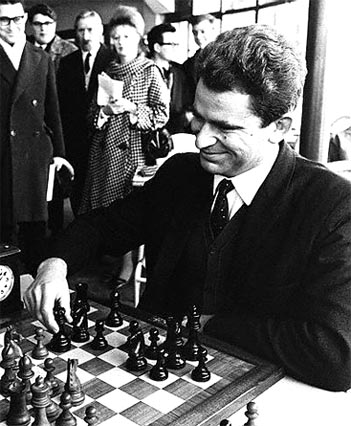
INTRODUCING BORIS SPASSKY

Spassky, born in 1937, learned to play chess at the age of five while on a train evacuating his hometown Leningrad (now St. Petersburg) during World War II.

He made steady progress, and by the age of 10 was a recognized talent. There is a famous photo from 1947 of Spassky giving future World Champion Botvinnik a tussle in a simultaneous exhibition, when the former was a 10-year old boy. It was clear that young Boris had more potential than the other kids.

In 1955, Boris Spassky became the 3rd World Junior Chess Champion, in the process becoming an International Grandmaster. Spassky had achieved the GM title at 18 years old, and while today this would not be considered a big deal, it was a world record at that time!

Continuing his climb, Spassky played with great success in international tournaments, and survived the incredibly tense Moscow Zonal tournament of 1964, then tied for first in the 1964 Interzonal at Amsterdam, and advanced to the World Championship Match against Tigran Petrosian by knocking out all of his opponents in the 1965 Candidates Matches: Keres, Geller, and Tal. The first two are legendary players, and Tal of course made it to the summit in 1960.

Spassky had to face polar opposites back-to-back: the mad-attacking Mikhail Tal in the 1965 Candidates Final, and the defensive Tigran Petrosian in the 1966 World Championship Match. Spassky's universal style almost allowed him to pull it off: he beat Tal 7-4 in the Candidates Final, but lost to Petrosian by a single point (12.5-11.5) in the title match. We can credit this to Spassky's "universal style": he was able to do everything well, seemingly equally comfortable in all types of positions.

After losing in 1966, Spassky had to make a climb all over again to get another shot at Petrosian. By virtue of making the World Championship match, he would not have to battle in the Interzonal, but that still left three difficult Candidates Matches just for another title shot! Spassky managed in the 1968 Candidates Matches to knock out Geller, Larsen, and Korchnoi in succession, and each by a margin of three points! This gave him the right to face Petrosian again in the 1969 World Championship Match, which he won by a score of 12.5-10.5. Thus, Boris Spassky became the 10th World Chess Champion.

Spassky was a very strong player during his best years and, notably, dominated Bobby Fischer each time they faced each other in a tournament or in their super-hyped game in the 1970 Siegen Olympiad.

Beginning in 1970, however, it was clear that there would be a showdown in 1972, as Fischer was mowing down everyone in sight. After Fischer beat Petrosian in the 1971 Candidates Final, the 1972 World Championship Match was set.

The recent match (September-October 2006) between Topalov and Kramnik reminded many of the '72 match between Fischer and Spassky. Boris Spassky had a reputation then (and now) of being a complete gentleman, letting his play do the talking. On the other hand Fischer...
This match was more than just a chess match, unfortunately. It was billed a Cold-War showdown, Spassky being from the Soviet Union and Fischer from the United States. U.S. Secretary of State Henry Kissenger called Fischer to get him to play. Taimanov and Petrosian, after losing to Fischer, had been severely punished by the Soviet State.

In a match more remembered for its off-the-board antics (Fischer forfeited Game 2; Spassky's team alleged that Fischer had chemicals sprayed into the air or was hypnotizing Spassky) than its chess, Fischer won "The Match of the Century" by a final score of 12.5-8.5. Fischer was unstoppable during those years, and unfortunately Spassky was the man standing in the way.

Spassky was reprimanded for losing the match against Fischer, and the next year, in 1973, the USSR organized a "Super-Final," where ALL of the top stars from the Soviet Union were "invited" to play. Boris Spassky, the ex-Champion humiliated in his country, managed to win this supertournament.

Spassky continued to post strong results in tournaments, but never was a title contender again; he tired of all the work and preparation it took. He was a man whose life was not dominated by chess. Spassky emigrated to France in 1978 and has played under the French flag ever since.

Spassky is a very popular lecturer in, of all places, the United States! In this country there are as many fans who love Fischer as hate him, but Spassky is universally admired by all chessplayers the world over.


To see a biography of Boris Spassky on Wikipedia, click here.

To see the games of Boris Spassky on ChessGames.com, click here.

11/10/2006

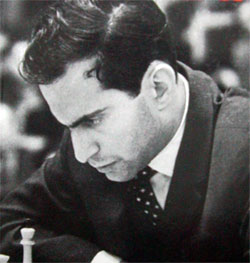
INTRODUCING TIGRAN PETROSIAN

The 9th World Champion, Tigran Petrosian of Armenia, was born in his native country in 1929, living his childhood in Tblisi, Georgia. Georgia was—and remains to this day—a strong chessplaying country, especially when it comes to women's chess: Nona Gaprindashvili (1962-1978) and Maia Chiburdanidze (1978-1991) both became Women's World Champions.

Petrosian learned how to play chess at 8, and credits learning other games such as checkers at the age of 4 for helping him make quick progress. When he moved to Moscow in 1949, he really made progress, winning a lot of tournaments including Moscow 1951.

Petrosian qualified for the 1952 Interzonal tournament held in Stockholm, Sweeden, finishing in a tie for 2nd place. This qualified him to participate in the 1953 Candidates Tournament at Zurich, where he finished in 5th place, a more than respectable result considering that this is considered one of the strongest tournaments ever held.

Petrosian then qualfied for the next three Candidates Tournaments: equal 3rd in Amsterdam 1956 (won by Smyslov), third in Yugoslavia 1959 (won by Tal), and finally first in Curacao 1962.

The winner of the Candidates Tournament (later to be replaced by the Candidates Matches) would gain the right to play a World Championship Match. For winning Curacao 1962 Petrosian got the chance to challenge Mikhail Botvinnik for the title. In doing so, Petrosian is the only player ever to go through both the Interzonal and the Candidates without losing a single game! Fischer, during his magical run in 1970-71, where he won 20 consecutive games at one point, lost two games.

Petrosian overcame the Soviet patriarch in the 1963 World Championship Match by a final score of 12.5-9.5, doing so on the strength of his tough, defensive, positional chess. Tigran Petrosian really was "an immovable object." An opponent would have to play absolutely brilliant chess—tactically and strategically, to win a game from him. He was the complete opposite of Tal in his style!

FIDE had at this time instituted a rule that eliminated the "return matches" that Botvinnik had benefitted so greatly from during his long reign. To challenge Petrosian for the title, Botvinnik would have to go through the Candidates again, something the 52-year old did not wish to do. Therefore, Petrosian was guaranteed to be more than a "Winter King": he would hold the title until at least 1966.

Petrosian's challenger in 1966 was Boris Spassky. Spassky at this time was already World Championship-calibre material, but Petrosian won the match by a score of 12.5-11.5. The match was tied after 19 games, then Petrosian won games 20 and 22, taking a two-point lead. Spassky came back to win Game 23, but could only draw the final game. Petrosian was the first World Champion since Alekhine to successfully defend his title after winning it in a match.

Spassky came all the way back to challenge Petrosian in 1969, defeating the champion by a score of 12.5-10.5.

Petrosian is remembered for being a "boring" positional, defensive player, which limits his popularity, but there was more to him than this. Petrosian was a brilliant tactician: the reason for this is that in many ways it is harder to defend than attack. When attacking, one does not usually need to calculate everything, but can build up their position. In defending, one must see all the opponent's plans and threats in order to react to them.

Petrosian, with his "negative" chess, added greatly to our understanding of prophylaxis: stopping the opponent's play in its tracks before it has even started. This has become ever more important in contemporary play.

The 9th World Champion competed successfully in tournaments till the end of this life in 1984, when he died of stomach cancer.
To see a biography of Tigran Petrosian on Wikipedia, click here.
To see the games of Tigran Petrosian on ChessGames.com, click here.

11/08/2006

INTRODUCING MIKHAIL TAL

Mikhail Tal, born in 1936 in Riga, the capital of Latvia, is one of the historically most popular chess players from a stylistic perspective—he was the modern Paul Morphy: uncompromising chess, attacking, striving for the initiative...and he lived his life as he played the game.

Tal learned how to play chess at 8 and attended, as did many other future top Soviet players, a "Pioneer Palace." These were essentially chess clubs/training centers for promising junior chessplayers, and they were set up all over the Soviet Union. It may be said that the Pioneer Palaces were the root of the Soviet chess dominance that exists to this day (though there is no longer a Soviet Union, Russia, Ukraine, etc. are constantly churning out chess mega-stars).
At the Pioneer Palace, Tal did not show a great deal of promise, but worked hard to improve, being trained by Alexander Koblentz (who remained his trainer even in his World Championship days). In hindsight it is clear that Tal had different ideas about how chess should be played, and was still in the process of "finding himself" and making it all work while in eary adolescence.

In 1953 Tal became Latvian Champion, not a bad achievement, good enough for the Candidate Master title (this would probaby be equivalent to a player of about 2100-2200 strength today).

In 1956 Tal qualified for the Soviet Championship, finishing in a tie for 5th place. For a person without international experience, this was an enormous accomplishment. Could he do better in the future? He could: Mikhail Tal won the Soviet Championship in 1957 at 20 years old ahead of a long list of legendary chess figures. This achievement cannot be overstated: the Soviet Championship (and today the Russian Championship) is by a good margin the toughest in the world to win.

FIDE, the International Chess Federation, took an unprecedented step because of this achievement: Tal, by virtue of becoming Soviet Champion, was awarded the title of International Grandmaster, even though he had not competed in enough international events. Undoubtedly, anyone who wins the Soviet Championship is Grandmaster strength, and a strong Grandmaster at that.
Tal defended his title in 1958, and then won the Interzonal in Potoroz, the first step to becoming THE CHAMPION. The top 6 finishers qualified for the 1959 Candidates Tournament in Yugoslavia, plus the top two finishers in the previous Candidates Tournament, including Smyslov who had lost the World Championship match to Botvinnik. In the 28-round Candidates Tournament everyone would play four games agains the other competitors. Tal won the event with 20/28, a margin of 1.5 points and, most notably, defeated Bobby Fischer 4-0 in their encounters.

This gave Tal the right to face Mikahil Botvinnik in the 1960 World Championship Match. Shunning the "rules" of how modern chess "should" be played, Tal defeated Botvinnik 12.5-8.5 in a match that was as much about chess ideology as it was about chess. The 23-year old became the 8th and youngest World Champion ever.

Right after becoming Champion, Tal began to suffer from the health problems that would plague him for the remainder of his life. He was constantly hospitalized, even in 1961 when the return match against Botvinnik was scheduled. Instead of postponing the match, Tal played anyway, but lost by 5 points. Tal made no excuses, though his chronic kidney ailments were very real.

Tal was automatically seeded into the 1962 Candidates Tournament at Curacao, but was forced to withdraw to be hospitalized for kidney problems. In the 1965 Candidates matches, it is said that he suffered several heart attacks.

Tal continued to play top-level chess, but never again challenged for the Title. He won numerous international events, won five Interzonal Tournaments, and six Soviet Championships (the last in 1978). Tal was a chain-smoker and heavy drinker, and this very likely contributed to his health problems. Tal died in 1992 at the age of 54.

Tal loved the game of chess and was known to play blitz for hours on end. He loved meeting and talking with spectators, an extremely popular figure.


To see Mikhail Tal's biography on Wikipedia, click here.

To see Mikhail Tal's games on ChessGames.com, click here.

11/06/2006

INTRODUCING VASILY SMYSLOV

Vasily Smyslov, born in 1921, was one of the world's best players from the 1940s. He was selected to play in the 1948 World Championship Match-Tournament, to decide Alexander Alekhine's successor (who had died in 1946 with the title, creating a vacancy). Smyslov finished second behind Mikhail Botvinnik, who became World Champion.

In 1953, Smyslov participated in the Zurich International Tournament. This was the "Candidates Tournament," and the winner would challenge Botvinnik for the Championship the next year. Smyslov won the 15-player, 28-round(!), two-month event with a final score of 18 points out of 28. This was two points better than his nearest rivals, and he won the right to challenge Botvinnik in the 1954 World Championship Match.

The Match ended in a 12-12 tie, as had Botvinnik's match with Bronstein in 1951. In both cases the champion retained the title due to "draw odds": the challenger had to score at least 12.5 points in 24 games to win the title, but the champion needed only 12 points to retain it.

Undaunted by this, Smyslov emerged victorious in the 1956 Candidates Tournament in Amsterdam, and challenged Botvinnik again in the 1957 World Championship Match. This time he won the title by a score of 12.5-9.5, and became the 7th World Chess Champion. The next year, however, Botvinnik won the "return match" by a score of 12.5-10.5. Having played in three World Championship matches in four years, Smyslov would never reach another one, although a quarter century later he would get close...

Continuing to try and qualify for another shot at the Title, Smyslov qualified for the Candidates Matches in 1983 (Fischer's accusations of Soviet collusion had gotten FIDE to scrap the Candidates Tournaments in favor of the Matches beginning in 1965). After beating Robert Huebner on the spin of a roulette wheel (their match was tied 7-7), he knocked out Zoltan Ribli in the Candidates Semi-Final, and at the age of 62, challenged Garry Kasparov for a chance to face Anatoly Karpov in the 1984 World Championship Match. Even though Kasparov won the match 8.5-4.5, the ability to reach a Candidates Final 25 years after last playing in a World Championship match is simply unheard-of!

Smyslov became known as one of the "Winter Kings" as he had held the Championship for only one year, but this should not dimish how great a player Smyslov was. He is not one of the most popular world champions because of his positional style, but his play was very "clear" and, it often appeared, effortless. This man simply had a deep understanding of chess!
Now 85 years old, Smyslov no longer plays tournament chess. He made the decision to become a professional chessplayer after he auditioned for the Bolshoi Theatre in 1950. He was known as a fine baritone singer.


To see a biography of Vasily Smyslov on the Wikipedia website, click here.

To see Smyslov's games on ChessGames.com, click here.

11/03/2006

INTRODUCING MIKHAIL BOTVINNIK

Mikhail Botvinnik was born in 1911, and showed promise early: he defeated then-World Champion Jose Raoul Capablanca at 14 years old in a game in a simultaneous exhibition. By the 1930s he had become one of the best players in the world, winning the always-strong Soviet Championship for the first time in 1931 (he would win it 6 times), and tied for first in the Moscow 1935 and Nottingham 1936 supertournaments.

Alexander Alekhine, who was World Champion from 1927-35 and regained the title in 1937, died in 1946 while holding the title. That left a vacancy for the crown: a new champion was needed! After considering awarding the title to Max Euwe, the last living World Champion, the solution was a match-tournament to decide the next champion.

The tournament was held from March-May 1948. The field included Euwe, Samuel Reshevsky (United States), Paul Keres (Estonia), Vasily Smyslov (Soviet Union), and Botvinnik (Soviet Union). Botvinnik emerged victorious, becoming the 6th World Champion.

At this time FIDE (the International Chess Federation) gained control of the chess world, and scrapped the system that allowed previous world champions to hand-pick their opponents. Now, there was a three-year cycle: Zonal tournaments in regions around the world, whose winners would qualify for Interzonals. The top finishers from the Interzonals would play in a marathon Candidates Tournament to decide who would challenge the World Champion.

In 1951 Botvinnik drew a match with David Bronstein for the Title, 12-12. The champion had draw odds, so Botvinnik kept the title. He defeated Smyslov in the 1954 World Championship match before losing the title to him in 1957. He regained it the next year.

In 1960 Botvinnik lost the title to the fearsome attacker Mikhail Tal, but regained the title from hin the next year. Botvinnik lost the title for the last time to Tigran Petrosian in 1963.

Botvinnik, like his predecessors, was also gifted outside of chess. He was an electrical engineer, gaining a doctorate in this field. After retiring from international play in 1970, Dr. Botvinnik spent the remainder of his life working the field of computer chess and, of course, training "talented" future stars of Soviet chess. His most successful pupils: Anatoly Karpov and Garry Kasparov, the 12th and 13th World Champions. Botvinnik is often referred to as the "Patriarch" of Soviet Chess, and this is well-deserved--for better and for worse!

Botvinnik played chess as he lived his life: according to iron logic! He was not the most talented chessplayer ever, but he certainly was one of the first to take a highly professional approach to training, training for several hours everyday.


To see a biography of Mikhail Botviniik at the Wikipedia website, click here.


To see Botvinnik's games at ChessGames.com, click here.

11/01/2006

INTRODUCING MAX EUWE

The 5th World Champion, a Dutchman named Max Euwe (pronounced "Erver," born in 1901) won the title by defeating Alexander Alekhine in a match in 1935. While many people say that this was due to Alekhine's personal problems at that time, Euwe was legitimately a super-strong chess player for decades.

Euwe may well be the strongest "amateur" chessplayer ever. How can a world champion be considered an amateur? Well, Euwe's primary career was as a mathematics professor, much like the 2nd World Champion Emanuel Lasker. Dr. Euwe was considered a gentleman and generally admired by all. Unlike Lasker, who avoided Capablanca as long as possible; and Capablanca, who insisted upon very difficult conditions for challengers (a $10,000 stake in Gold); and Alekhine, who avoided even playing in the same tournaments as Capablanca; Euwe graciously agreed to a rematch with Alekhine in 1937. However, Alekhine returned to his best form and regained the title.

Euwe put in strong performances in many top-flight events, such as Nottingham 1936 and AVRO 1938, and continued to be a formidable opponent into the 1950s, participating in the 28-round marathon Zurich 1953 event.

A great chess teacher, Max Euwe's legacy includes many books, including Judgment and Plannign in Chess, A Guide to Chess Endings, and his most famous work The Middlegame (Books 1 and 2), among many others.

Euwe later became the President of FIDE (the International Chess Federation) and it was largely through his efforts that the often-impossible to deal with Robert James Fischer finally agreed to play (and subsequently win) the 1972 World Championship match. His tenure lasted from 1970-1978.

Euwe died in 1981 at the age of 79.

"There is something wrong with that man. He's too normal." --Bobby Fischer.


To see a complete biography of Max Euwe on the Wikipedia site, click here.

To see a games collection of Max Euwe on ChessGames.com, click here.

10/27/2006

INTRODUCING ALEXANDER ALEKHINE

Born in 1892, Alexander Alekhine showed much promise early and made his debut in top-flight tournament competition in 1911, coming 8th-11th place in Karlsbad. At St. Petersburg 1914, one of the strongest chess tournaments ever held, Alekhine was one of the five top finishers, and on these players Czar Nicholas II conferred the title of "Grandmaster," the precursor of the official FIDE title.

Alekhine won a string of very strong tournaments, and was one of the top players in the world, finally getting sponsored for a World Championship Match with Jose Raoul Capablanca, who was a heavy favorite to win. Nevertheless, Alekhine overcame the once-invincible Capablanca in the 1927 World Championship Match in Buenos Aires. His work ethic and tireless preparation allowed him to beat the talented Cuban by winning 6 games, losing only 3 and drawing 25. The rook ending where he won the 34th and decisive game is a classic.
After this, Alekhine became easily the most dominant player in the world. He won numerous tournaments, often with crushing scores, such as his triumph in San Remo 1930: 13 wins and 2 draws! Aron Niemzowitsch finished second, 3.5 points behind.

Alekhine avoided a rematch with Capablanca, and defeated Efim Bogolyubov in two matches, in 1929 and 1934. "Bogo" was considered a top player, but is not remembered as an all-time great.

In 1935 Alekhine, reputedly suffering from alcoholism, lost his world championship title to the next World Champion, Max Euwe, by a narrow margin. Euwe, however, was a legitimately great player who often does not get the credit he deserves. Still, he was not as strong as Alekhine.
In 1937, overcoming his challenges, Alekhine won the rematch against Euwe, winning fairly easily. In large part because of the outbreak of World War II, there were no more championship title defenses from Alekhine, until one was arranged between he and Mikhail Botvinnik in 1946. However, the details could be worked out, Alekhine breathed his last.

Alekhine was tremendously strong in all phases of the game: he played the opening very incisively and often gained large positional advantages in that stage, enough for him to convert without much trouble. In the middlegame he was equally skilled in attacking play and strategic play; and his endgame ability is very underrated. Garry Kasparov considers him the greatest player ever and there is some basis for this argument, namely how he so completely dominated his peers while at his peak.
To see a complete biography of Alekhine, check out his Wikipedia page.
To see some of Alekhine's games, check out his page on ChessGames.com.

10/26/2006

INTRODUCING JOSE RAOUL CAPABLANCA

The 3rd World Chess Champion, Jose Raoul Capablanca of Cuba, is unique among all chessplayers. There is no way to know for sure, but it is very likely that Capablanca is the most naturally-talented chessplayer who has ever lived. Some may argue that this accolade belongs to Paul Morphy, but his opponents were nowhere near as strong as those that Capablanca would face. Modern champions like Botvinnik, Fischer, and Kasparov were incredibly hard-working, as was Capablanca's successor Alekhine.

Born in 1888, Capablanca was reputed to have learned the game of chess at the age of 4 simply by watching his father and a friend play. The child even insisted that his father moved the knight improperly! Capablanca's father challenged Jose to a game, but lost to the 4-year old...

Capablanca became champion of his country at the age of 12 by defeating Juan Corzo in a match. If that happened today, the boy would have been headline chess news around the world and would be sponsored to receive the best training and tournament opportunities. But in those days, that was not the case, and there were also a much lower number of strong tournaments.

It wasn't until 1909 that Capablanca really gained worldwide attention: he defeated the new U.S. Champion Frank Marshall in a match by the crushing score of 8-1 with 14 draws. To show how extraordinary a feat this was, bear in mind that Marshall would remain U.S. Champion until 1936—and not because he was defeated, but because he retired!
It was the vanquished Marshall who insisted that Capablanca be allowed to play in the very strong San Sebastian tournament of 1911. This was the Cuban's international debut, and he won the tournament! After racking up more and more international victories, Capablanca challenged Lasker for the World Championship. Lasker, believe it or not, resigned the title to Capablanca in 1920, but they played a match the next year. Capablanca led the match 4-0 with 10 draws before Lasker resigned that match.
Capablanca played tens of thousands of games in simultaneous exhibitions over the course of his career, but he lost no tournament games from 1916 to 1924! This is feat is unmatched. Capablanca was considered invincible, and with good reason: no one understood chess better, played the game so clearly and cleanly, and no one—even to this very day—has ever surpassed Capablanca's endgame technique.

The next world champion, Alexander Alekhine, defeated Capablanca in the 1927 World Championship match held in Buenos Aires, Argentina. It is widely believed that if the two played another match, Capablanca would have won, but Alekhine never offered him a rematch, and years later said that he could not explain how he managed to win in 1927. Still, Capablanca was one of the top players in the world, until his health began to fail him at the end of the 1930s. He died at the Manhattan Chess Club in 1942.

Alekhine said: "With his death, we have lost a very great chess genius whose like we shall never see again."

So true. In the modern age of chess, top players are made, not born.


To see a full biography of Capablanca from Wikipedia, click here.
To see the games of Capablanca, go to ChessGames.com.

10/25/2006

INTRODUCING EMANUEL LASKER

Dr. Emanuel Lasker (born in 1868), the 2nd World Chess Champion, is Germany's greatest ever chessplayer. He was a brilliant mathematician as well, university professor, and a good friend of Albert Einstein.

The current World Champion, Vladimir Kramnik, considers Lasker to be much stronger than his predecessor Wilhelm Steinitz, saying that if Steinitz was a 2400 strength player, then Lasker was 2700 strength. Lasker continued to develop positional chess play, and he was a big part of bringing chess into the modern era. He also began to professionalize chess by getting appearance fees to play, something Fischer would take to the next level.

Lasker became World Champion by defeating Steinitz in a match in 1894. He held the world title for an amazing 27 years straight, before finally losing to the next World Champion Jose Raoul Capablanca. Even after he lost the title, Lasker's longevity as a top player was astonishing: He won the New York 1924 tournament at the age of 55!

Lasker was known as a psychological player. He was known to purposely not always play the best move if he thought a different move would cause his opponent more problems psychologically. He was from the school that one should "play [against] the man (or woman!), not the board!"

Lasker was also an author. His most famous chess work was Lasker's Manual of Chess. He died in New York in 1941.


To see a complete biography of Lasker, see Wikipedia here.

To see Lasker's games on ChessGames.com, click here.

10/23/2006

INTRODUCING WILHELM STEINITZ

Born in 1836 in Prague, Czechoslovakia. Wilhelm Steinitz began has career as a chess professional at 26 (a very late age by today's standards!) but became recognized as the unofficial World Champion in 1866. He retained the unofficial title until 1886, when the chess world officially recognized World Champions.

So in 1886 Steinitz became the first Official World Chess Champion. He was outstanding in match play, defending his unofficial and official titles a number of times, before losing a World Championship match to Emanuel Lasker in 1894


Steinitz's most important contributions were not only his games, but his theories. In the age of Romanticism, where the way to play was a slashing style with a lot of unsound sacrifices, Steinitz stated: "One should only attack when one has an advantage," and "The player who has the advantage MUST attack, or else the advantage will disappear." [The attack does not always have to be against the king; it can be against, for example, weak pieces]. This may not sound very significant, but it laid the foundation for the chess that is played today. Because Steinitz played so many opponents who would attack just for the sake of attacking, his games showed how to play good defense.
To see more information from Steinitz on Wikipedia, click here.
To see Steinitz's games on ChessGames.com, click here.

10/20/2006

INTRODUCING PAUL MORPHY

Paul Morphy (1837-1884) was one of the "unofficial" World Champions of the 19th century (the first official World Champion was Wilhelm Steinitz in 1886). He is considered by many to be one of the greatest chess players and chess geniuses of all time.
Morphy was born in New Orleans, Louisiana and learned the game from his father, Alonzo. When Morphy grew up, he became a lawyer, following in the footsteps of his father, who was a judge. However, his mark on the world would be his chessplaying ability—he defeated all of the best players in the world who would face him, and in crushing fashion. In fact, Morphy was so far ahead of his contemporaries that most of his games are those where he gave "odds": he played without a knight, or a rook, or pawn and move, to make the game a decent fight!
Morphy later withdrew from playing serious chess, and passed away in 1884.
Morphy's ability to play the Open Games (Games beginning with 1.e4 e5), with both colors, is unsurpassed in the history of chess, even to this day. This is a strong statement, since even in 1900 chess theory was significantly more advanced than it was in Morphy's day.
To see a full biography of Morphy on Wikipedia, click here.
To see Morphy's games on ChessGames.com, click here.

9/25/2006

VESELIN TOPALOV

VESELIN TOPALOV
Born on March 15, 1975 FIDE World Chess Champion 2005 Runner-up FIDE World Championship 2005 July 1 2006 Rating – 2813 Assistants: Ruslan Ponomariov, Ivan Cheparinov Manager Silvio Danailov
Talent for bright combinations. Aggressive chess-player. Successor of famous masters of attack: Morphy – Chigorin – Alekhine – Tal – Kasparov. Having absorbed the best of his predecessors, Topalov added modern universalism and splendid openings to his style. Bulgarian grandmaster is distinguished by his maximalism. He spends more time at chess board than any other player. He finds resources to carry on fighting even in an absolute drawn position. Boundless span of energy which Veselin seems to have enables him to keep his opponents under constant pressure during the long hours of a game and long days of a tournament.Topalov evolved from a promising junior into an elite grandmaster slow and hard. In accordance with his aggressive style bright victories of a growing talent were followed by striking failures. Unstable performance didn’t allow Veselin to engage in a battle for world championship. Yet in a series of elite tournaments in the mid 90’s he broke through and scored a success. And as it turned out it was only the beginning of his career.At the dawn of a new century Topalov has made another breakthrough – he advanced in technique, deepened his openings and gained psychological stability. It is a rare case – a mature player improved his class of play, from a high class to the highest!Even so, Topalov preserved his youthful ardor and true fighting spirit. He still plays to win with either color and in any position, bravely upsets the balance in spite of any jeopardies. Such risky manner of playing is a real means to popularize chess in the world. Millions of chess fans all over the world watch exciting thrillers performed by a Bulgarian grandmaster.For today Topalov has practically no weak points. He is strong as never before! If previously his failures would negatively show in his following games, now the reverse is true – after losses he doesn’t look for a compromise and shows his best play. After the tournament in Sofia, 2006 Topalov for the first time in his career has surpassed great Kasparov in rating. Having crossed this symbolic Rubicon, Bulgarian grandmaster obtained the status of player number 1 in the world.What is Topalov’s objective in the match vs Kramnik? The main thing is to maintain high tension constantly making the opponent solve complicated non-trivial tasks. The more fierce the battle, the better are chances of the chess athlete to win.Veselin is likely to turn his endurance to the advantage. In the second half of the match Vladimir is to go through a hard test. Born on March 15, 1975 FIDE World Chess Champion 2005 Runner-up FIDE World Championship 2005 July 1 2006 Rating – 2813 Assistants: Ruslan Ponomariov, Ivan Cheparinov Manager Silvio Danailov
Talent for bright combinations. Aggressive chess-player. Successor of famous masters of attack: Morphy – Chigorin – Alekhine – Tal – Kasparov. Having absorbed the best of his predecessors, Topalov added modern universalism and splendid openings to his style. Bulgarian grandmaster is distinguished by his maximalism. He spends more time at chess board than any other player. He finds resources to carry on fighting even in an absolute drawn position. Boundless span of energy which Veselin seems to have enables him to keep his opponents under constant pressure during the long hours of a game and long days of a tournament.Topalov evolved from a promising junior into an elite grandmaster slow and hard. In accordance with his aggressive style bright victories of a growing talent were followed by striking failures. Unstable performance didn’t allow Veselin to engage in a battle for world championship. Yet in a series of elite tournaments in the mid 90’s he broke through and scored a success. And as it turned out it was only the beginning of his career.At the dawn of a new century Topalov has made another breakthrough – he advanced in technique, deepened his openings and gained psychological stability. It is a rare case – a mature player improved his class of play, from a high class to the highest!Even so, Topalov preserved his youthful ardor and true fighting spirit. He still plays to win with either color and in any position, bravely upsets the balance in spite of any jeopardies. Such risky manner of playing is a real means to popularize chess in the world. Millions of chess fans all over the world watch exciting thrillers performed by a Bulgarian grandmaster.For today Topalov has practically no weak points. He is strong as never before! If previously his failures would negatively show in his following games, now the reverse is true – after losses he doesn’t look for a compromise and shows his best play. After the tournament in Sofia, 2006 Topalov for the first time in his career has surpassed great Kasparov in rating. Having crossed this symbolic Rubicon, Bulgarian grandmaster obtained the status of player number 1 in the world.What is Topalov’s objective in the match vs Kramnik? The main thing is to maintain high tension constantly making the opponent solve complicated non-trivial tasks. The more fierce the battle, the better are chances of the chess athlete to win.Veselin is likely to turn his endurance to the advantage. In the second half of the match Vladimir is to go through a hard test.

9/24/2006

VLADIMIR KRAMNIK

Vladimir Kramnik
Born on June 25, 1975Winner of Chess Olympiads 1992, 1994, 1996, as a member of the Russian team Winner of “Grand Prix Intel” in rapid chess 1997 July 1 2006 rating – 2743 Assistants: Peter Svidler, Migel Ilyeskas, Manager Karsten Hensel
An outstanding player of positional game, brilliant master of defense, one of the most erudite players of our time. Vladimir has chess at his fingertips. He gets a deep insight into a position, seeing the whole picture with the slightest nuances, often without any calculation of variants. In addition he has a wonderful sense of initiative. On the surface the cautious academic style of Kramnik’s play may seem rather deceptive. Once the position gets sharper, we see a wonderful tactician able to sacrifice and play in a very aggressive manner. He plays the position, that’s all there is to say about it. If the positional considerations suggest sacrifice, Kramnik is sure to sacrifice. Most victories Kramnik wins in a technical style. Yet this is the consequence of his frugality and pragmatism. In this way he is similar to Karpov. Kramnik is a disciple of Botvinnik-Karpov school. Great teachers saw his unique talent and taught all the subtleties of grand chess to him. And at the same time his innate style matured too. Very soon the young student began to show good results and was found among adult chess players.Throughout the ‘90s Kramnik has been successfully taking part in elite chess tournaments accumulating chess strength and gaining experience. For the time being, Kramnik’s career has reached its peak in the match against Kasparov (London, 2000). Vladimir managed to neutralize a formidable adversary and impose upon him a game of his own. After a short recession at the turn of the millennium Kramnik is again on the rise. His recent brilliant performance at the Torino Olympiad showed that Kramnik is up to the mark. He is young, eager to fight and he certainly does not want sportsmanship.In the forthcoming match with Topalov, Kramnik stands a good chance of winning. If Vladimir manages his power to last the whole distance, if he keeps the fight within the well-learnt schemes, if he shows his best as a positional virtuoso, then Veselin will have a hard time of it. What Kramnik can turn to his advantage is that Topalov is considered favorite in this match. High expectation of the world community and great responsibility may bind the Bulgarian chess player and prevent him from playing in an easy-going manner of his. Besides he does not have enough experience of playing in matches at such a high level. As for Kramnik, he passed through the hard school of Kasparov in childhood and in London match. Such experience is not to be substituted by any training.

9/23/2006

THE YOUNGEST GRANDMASTER IN THE WORLD


The previous blog entry mentioned Parimarjan Negi, the youngest grandmaster in the world and the second-youngest ever. The young Indian prodigy has completed all requirements for the coveted title, and should officially receive the title from FIDE (the World Chess Federation) in October.

The previous blog entry mentioned Parimarjan Negi, the youngest grandmaster in the world and the second-youngest ever. The young Indian prodigy has completed all requirements for the coveted title, and should officially receive the title from FIDE (the World Chess Federation) in October.