| Chess Live Exclusive Video Commentary Service! Acerook will be going the windmill tactics used in this game played by C. Torre vs. Em Lasker in 1925 Moscow. http://www.chess-live.com to join the fun on Chess Live, the world's most family-friendly, user-friendly, and best technology chess server. | |
Showing posts with label LESSONS. Show all posts
Showing posts with label LESSONS. Show all posts
11/18/2006
Chess Live Video -- C. Torre vs. Em Lasker Game Commentary


Chess Live Video -- Castling in Chess
| Chess Live Exclusive Video Service! Acerook(SR) will go over how to castle in chess. Chess Live currently offers FREE ROYAL MEMBERSHIP to all new members. http://www.chess-live.com to join the fun on Chess Live, the world's most family-friendly, user-friendly, and best technology chess server. | |
Chess Series
| Today a review of the Sicilian defense and we will watch very famous game between Bobby Fischer and Bent Larsen. | |
11/16/2006
Chess Live Video -- Byrne(GM) vs. Fischer(GM) Game of the Century
| Chess Live Exclusive Video Commentary Service! FIDE Master OnlyMove and Acerook will be going over the opening principles and thinking of this great game of Byrne(GM) vs. Fischer(GM) or called the Game of the Century. http://www.chess-live.com to join the fun on Chess Live, the world's most family-friendly, user-friendly, and best technology chess server. -- Please note during the video, I mistakenly say bring your king out, but what I meant was rook! | |
11/06/2006
LESSON: CANAL-HORVATH, BUDAPEST 1934
Esteban Canal-Imre Horvath
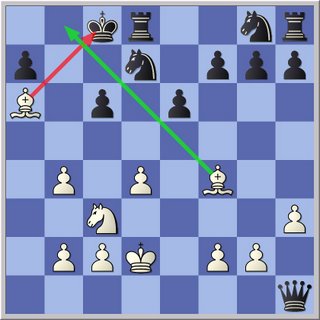 Black resigned here. The finish would have been: 13...bxc6 14.Ba6#! This is a fairly common pattern, the queen sacrificing itself this way with the bishop-crossfire checkmate. Most of the time, it happens when one side castles queenside.
Budapest, 1934
1.e4 d5
The Scandinavian Defense. This is a good choice to open a chess game with Black, simply because White cannot avoid it if he or she begins the game with 1.e4! White must do something, because Black is attacking White's e4-pawn.
2.exd5 Qxd5
Black recaptures the pawn. Black can also play 2...Nf6 and sacrifice the pawn for quick piece development. Here, Black gets a solid position, but the queen gets kicked around a bit.
3.Nc3 Qa5 4.d4 c6
Black controls d5 and b5. This may seem like a strange move, but Black wants to make sure White does not steamroll him in the center.
5.Nf3 Bg4
A good spot for this piece.
6.Bf4 e6 7.h3
White "puts the question" to the bishop: it must either trade itself for the knight or move away.
7...Bxf3 8.Qxf3 Bb4
Aggressive, but sound.
9.Be2 Nd7 10.a3
White puts the question to the other bishop! Black decides to not do anything with it, however...
10...0-0-0
This is a losing move, but it is not easy to see why. In chess, players often think that the opponent cannot play a certain move, and when they do it anyway, it is a terrible shock.
11.axb4
Excellent! White sees to the end of the game. This is not a hard move to make, if you LOOK FOR IT and know the idea White has--it is common, actually.
11...Qxa1+ 12.Kd2
White says: "Take my rooks!" This was also the title of a chess book.
12...Qxh1 13.Qxc6+
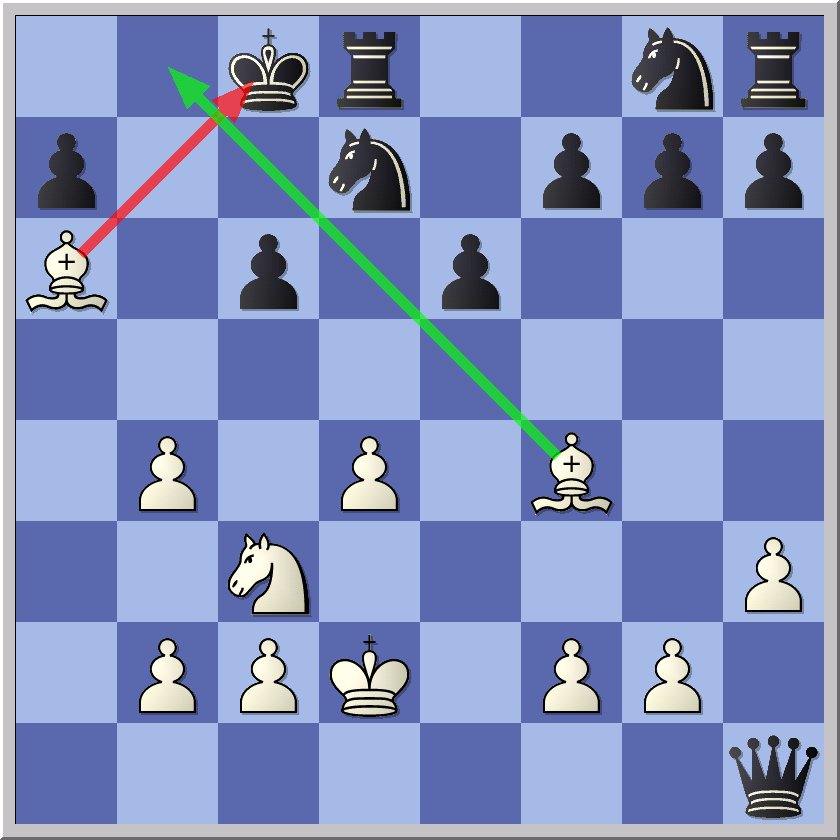 Black resigned here. The finish would have been: 13...bxc6 14.Ba6#! This is a fairly common pattern, the queen sacrificing itself this way with the bishop-crossfire checkmate. Most of the time, it happens when one side castles queenside.
What did we learn from this game?
1. Openings that force the opponent to make a decision right away can be a good choice, because they cannot be avoided!
2. Be prepared for unexpected tactical shots from your opponent.
3. It is a good idea to become familiar with as many tactical themes as you can: by knowing the double-rook sacrifice and the bishop-crossfire checkmate, the move 11.axb4 was easy for White to play.
4. Don't assume your opponent cannot play a move: maybe there is a way to "make it work" that you didn't count on.
11/03/2006
LESSON (LEVELS 3-4): HOLZHAUSEN-TARRASCH, 1912
This game shows a pattern that students at Levels 3-4 (or above!) in the NYChessKids 10 levels of education can learn from. The game is simple, but the pattern (that either wins the queen or leads to checkmate) is one to remember.
The loser of this game is Siegbert Tarrasch, who was one of the strongest chessplayers in the world during his life. He played in several World Championship matches, but was never quite strong enough to win the title. Still, he is considered a great chess teacher of the classics.
Walther von Holzhausen-Siegbert Tarrasch
Frankfurt, 1912
1.e4 e5 2.Nf3 Nc6 3.Bc4
White takes aim at the weak f7 square. Remember, the f7 and f2 squares are the weakest squares on the chessboard at the start of the game: these squares (and the pawns on them) are only defended by the King.
3...Nf6 4.d4 exd4 5.0-0
White opens up the game to develop his pieces, and then castles to get the King to safety. He can regain the pawn later.
5...d6
Black opens up his c8-bishop, but this restricts the f8-bishop to the e7-square. This means that Black will have less territory on the chessboard and must play a bit more of a defensive game.
6.Nxd4 Be7 7.Nc3 0-0 8.h3
Both sides are trying to finish developing their pieces. Black castles, and probably thinks that his king is now safe...White plays h3 to stop a bishop from landing on g4 and attacking the queen. It also makes a hole for the King to escape to, a good idea so that you don't fall into any back-rank mates.
8...Re8
Black moves his rook to a better file, but has to be careful because that rook was protecting the weak f7-square.
9.Re1
White does the same. Notice that White's f2-square is not as weak as Black's f7-square because there is no Black bishop on the diagonal leading to f2 (it is on e7).
9...Nd7
This is a losing move. Remember: don't move pieces twice in the opening unless you have a good reason to do it!
A better choice would have been 9...Ne5, which attacks the bishop on c4 and protects f7.
10.Bxf7+ Kxf7
If Black does not take, White will take the rook on e8.
 11.Ne6
This is the star move, and the point of the combination! The Black Queen is trapped by her own pieces and cannot move! The only way to save the queen is for the King to take the knight.
11...Kxe6 12.Qd5+ Kf6 (forced!) 13.Qf5#
Checkmate! The king was forced into the open and his own pieces took away retreating squares.
What did we learn from this game?
1. In the opening (ESPECIALLY when the game begins 1.e4 e5), it is more important to develop quickly and castle than it is to take pawns.
2. Watch out for the weak f7(f2)-square, especially if there is a bishop on c4(c5).
3. Don't move the same piece twice in the opening. Not only does it not help development, it can also lead to other problems (see Black's 9...Nd7 in this game).
4. Remember the idea of the Bxf7+ followed by Ne6 combination. It is very common, and 7-time US Champion Samuel Reshevsky lost a famous game with it to Bobby Fischer in 1958.
To play through this game on ChessGames.com, click here.
The loser of this game is Siegbert Tarrasch, who was one of the strongest chessplayers in the world during his life. He played in several World Championship matches, but was never quite strong enough to win the title. Still, he is considered a great chess teacher of the classics.
Walther von Holzhausen-Siegbert Tarrasch
Frankfurt, 1912
1.e4 e5 2.Nf3 Nc6 3.Bc4
White takes aim at the weak f7 square. Remember, the f7 and f2 squares are the weakest squares on the chessboard at the start of the game: these squares (and the pawns on them) are only defended by the King.
3...Nf6 4.d4 exd4 5.0-0
White opens up the game to develop his pieces, and then castles to get the King to safety. He can regain the pawn later.
5...d6
Black opens up his c8-bishop, but this restricts the f8-bishop to the e7-square. This means that Black will have less territory on the chessboard and must play a bit more of a defensive game.
6.Nxd4 Be7 7.Nc3 0-0 8.h3
Both sides are trying to finish developing their pieces. Black castles, and probably thinks that his king is now safe...White plays h3 to stop a bishop from landing on g4 and attacking the queen. It also makes a hole for the King to escape to, a good idea so that you don't fall into any back-rank mates.
8...Re8
Black moves his rook to a better file, but has to be careful because that rook was protecting the weak f7-square.
9.Re1
White does the same. Notice that White's f2-square is not as weak as Black's f7-square because there is no Black bishop on the diagonal leading to f2 (it is on e7).
9...Nd7
This is a losing move. Remember: don't move pieces twice in the opening unless you have a good reason to do it!
A better choice would have been 9...Ne5, which attacks the bishop on c4 and protects f7.
10.Bxf7+ Kxf7
If Black does not take, White will take the rook on e8.
 11.Ne6
This is the star move, and the point of the combination! The Black Queen is trapped by her own pieces and cannot move! The only way to save the queen is for the King to take the knight.
11...Kxe6 12.Qd5+ Kf6 (forced!) 13.Qf5#
Checkmate! The king was forced into the open and his own pieces took away retreating squares.
What did we learn from this game?
1. In the opening (ESPECIALLY when the game begins 1.e4 e5), it is more important to develop quickly and castle than it is to take pawns.
2. Watch out for the weak f7(f2)-square, especially if there is a bishop on c4(c5).
3. Don't move the same piece twice in the opening. Not only does it not help development, it can also lead to other problems (see Black's 9...Nd7 in this game).
4. Remember the idea of the Bxf7+ followed by Ne6 combination. It is very common, and 7-time US Champion Samuel Reshevsky lost a famous game with it to Bobby Fischer in 1958.
To play through this game on ChessGames.com, click here.
10/26/2006
ANDRE'S LESSON: UNDERSTANDING THE KING AND QUEEN CHECKMATE (BEGINNER)
Hi everyone! This is my first lesson on the NYChessKids Blog; I hope you enjoy it and learn from it!
I have found that it takes students awhile to really understand the King and Queen vs. King checkmate. I remember the first time I found myself with the extra queen: I was in 7th grade playing against one of my friends at lunch. I thought it was an easy win, but when lunch finished, I still had not been able to checkmate him! So I went and studied and finally figured it out (I never attended a chess class, and never took lessons until I was in college). We are going to go through it, so that you UNDERSTAND how it works.
Take out an empty chessboard (if you have one), or you can just imagine this:
Place the enemy king in the center of the board, say on e5. From here, the king can move to one of eight different squares (d4, d5, d6, e6, f6, f5, f4, or e4).
Now place this king on one of the edges of the board, say on e8. From here. the king can move to one of five different squares (d8, d7, e7, f7, or f8). With the enemy king still on e8, place the king of the attacking side (the side with the queen), on e6. Notice that the enemy king cannot go to d7, e7, or f7, because we would have kissing kings. Not a good thing! The king can only go to d8 or f8.
If we put the queen on a8, b8, c8, g8 or h8 it will be CHECKMATE! The king and queen work together to take away all of the king's escape squares.
Also, if we put the queen on e7, it will be CHECKMATE. The queen "gets in the enemy king's face!"
Remember these checkmating positions.
Now, how do we get to this? The answer is to drive the enemy king back to one of the edge squares. They are: a1-a8, a8-h8, h8-h1, h1-a1.
Here is an example: (White: King on e3, Queen on d3; Black: King on e5)
1.Qb5+ Kd6
Black would like to stay close to the center. If you cannot get the enemy king to one of the edge squares, you cannot give checkmate!
2.Ke4 Ke6 3.Qc6+
Notice that the Black king is being forced farther and farther back, until he has to go to the back edge. The White king is keeping the Black king from escaping because of "kissy-kissy."
3...Kf7 4.Ke5 Kg7 5.Qf6+ Kh7 6.Qg5
The magic move! The king is forced to go back and forth between h8 and h7 while White brings his king closer.
6...Kh8 7.Kf6 Kh7 8.Qg7#
Checkmate! The King and Queen worked together to make it happen.
What did we learn from this lesson?
1.To give checkmate with King and Queen, the enemy king must be forced to one of the edges of the board.
2.Because of the "no kissing kings" rule, the enemy king can be very restricted from moving.
3.Teamwork! The King and Queen must work together or there is no checkmate!
I have found that it takes students awhile to really understand the King and Queen vs. King checkmate. I remember the first time I found myself with the extra queen: I was in 7th grade playing against one of my friends at lunch. I thought it was an easy win, but when lunch finished, I still had not been able to checkmate him! So I went and studied and finally figured it out (I never attended a chess class, and never took lessons until I was in college). We are going to go through it, so that you UNDERSTAND how it works.
Take out an empty chessboard (if you have one), or you can just imagine this:
Place the enemy king in the center of the board, say on e5. From here, the king can move to one of eight different squares (d4, d5, d6, e6, f6, f5, f4, or e4).
Now place this king on one of the edges of the board, say on e8. From here. the king can move to one of five different squares (d8, d7, e7, f7, or f8). With the enemy king still on e8, place the king of the attacking side (the side with the queen), on e6. Notice that the enemy king cannot go to d7, e7, or f7, because we would have kissing kings. Not a good thing! The king can only go to d8 or f8.
If we put the queen on a8, b8, c8, g8 or h8 it will be CHECKMATE! The king and queen work together to take away all of the king's escape squares.
Also, if we put the queen on e7, it will be CHECKMATE. The queen "gets in the enemy king's face!"
Remember these checkmating positions.
Now, how do we get to this? The answer is to drive the enemy king back to one of the edge squares. They are: a1-a8, a8-h8, h8-h1, h1-a1.
Here is an example: (White: King on e3, Queen on d3; Black: King on e5)
1.Qb5+ Kd6
Black would like to stay close to the center. If you cannot get the enemy king to one of the edge squares, you cannot give checkmate!
2.Ke4 Ke6 3.Qc6+
Notice that the Black king is being forced farther and farther back, until he has to go to the back edge. The White king is keeping the Black king from escaping because of "kissy-kissy."
3...Kf7 4.Ke5 Kg7 5.Qf6+ Kh7 6.Qg5
The magic move! The king is forced to go back and forth between h8 and h7 while White brings his king closer.
6...Kh8 7.Kf6 Kh7 8.Qg7#
Checkmate! The King and Queen worked together to make it happen.
What did we learn from this lesson?
1.To give checkmate with King and Queen, the enemy king must be forced to one of the edges of the board.
2.Because of the "no kissing kings" rule, the enemy king can be very restricted from moving.
3.Teamwork! The King and Queen must work together or there is no checkmate!
10/25/2006
LESSON: LEGALL'S MATE
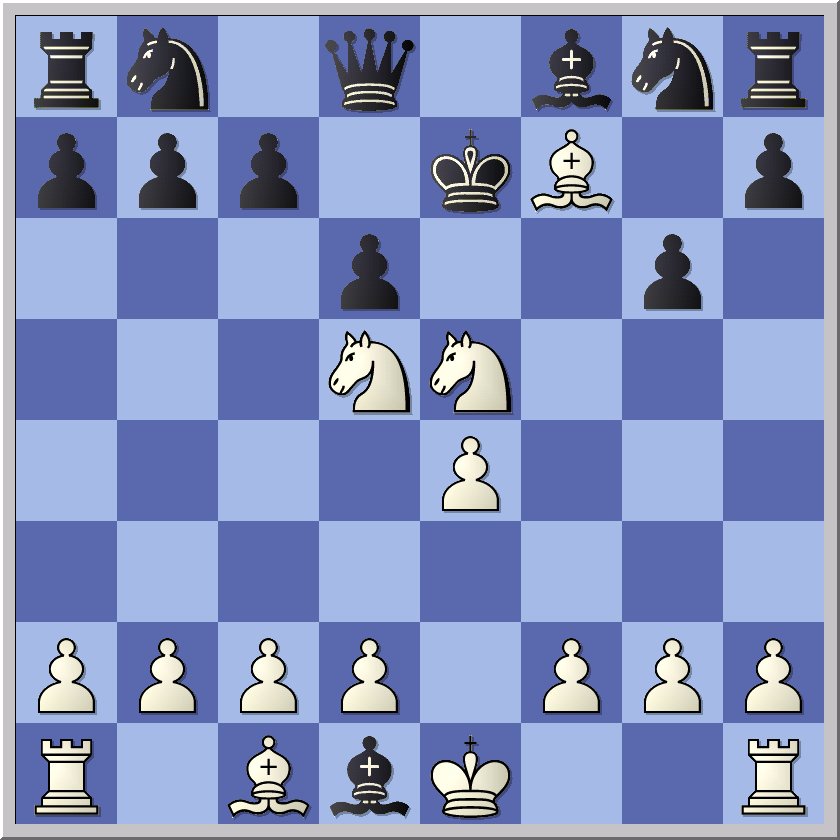 Legall's Mate
Pay close attention to this one, kids! This is a very famous pattern and it can win you some games! The trap came from a game played by Sire de Legall against St. Brie in 1750.
1.e4 e5 2.Nf3
The knight attacks the pawn on e5.
2...d6
Black protects the e5-pawn, but blocks in his bishop on f8
3.Bc4
White brings out his bishop and attacks the f7-square. Remember, at the beginning of the game, this is the weakest point on the board!
3...Bg4
The bishop pins the knight.
4.Nc3
White brings out another piece.
4...g6
This is too slow. Black should bring out PIECES and get ready to castle.
5.Nxe5
A sudden knight jump! But wait, doesn't White just hang the queen?
5...Bxd1
A queen is a queen...
6.Bxf7+ Ke7
The only legal move. Check it out for yourself!
7.Nd5# (see diagram at the top)
Checkmate! Black has no pieces that could help him, and the three white minor pieces end the game in the opening.
What did we learn from this game?
1. It is important to bring out your minor pieces (bishops and knights) early in the game.
2. Don't take material (even a queen!) if it allows your king to be attacked by many enemy pieces.
3. Respect your opponent! Maybe they see something that you do not see, so don't just think they made a blunder.
To learn more about the Legall mate, check out Wikipedia.
What did we learn from this game?
1. It is important to bring out your minor pieces (bishops and knights) early in the game.
2. Don't take material (even a queen!) if it allows your king to be attacked by many enemy pieces.
3. Respect your opponent! Maybe they see something that you do not see, so don't just think they made a blunder.
To learn more about the Legall mate, check out Wikipedia.
10/20/2006
SAUDIN'S LESSON ON MONDAY AT HORACE MANN SCHOOL
Paul Morphy - Duke Karl/Count Isouard, Paris, 1858
1.e4 e5 2.Nf3 d6 3.d4 Bg4 4.dxe5 Bxf3 5.Qxf3 dxe5 6.Bc4
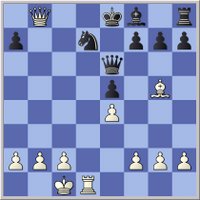
1.e4 e5 2.Nf3 d6 3.d4 Bg4 4.dxe5 Bxf3 5.Qxf3 dxe5 6.Bc4
White is threatening Qxf7+ checkmate.
6...Nf6 7.Qb3
White is now threatening both 8.Qxb7 and 8.Bxf7+
7...Qe7 8.Nc3
Black has stopped the threat to f7, but leaves b7 hanging. Morphy does not grab pawns, and instead brings out another piece. It has been said that Morphy never retreated a piece in his games!
8...c6
Black's queen now covers b7 and e7, but he is not bringing out any pieces!
9.Bg5
White brings out another piece and pins the knight.
9...b5
A bad move. Black is moving his pawns around, but is not developing...
10.Nxb5 cxb5 11.Bxb5+
A very strong sacrifice: White gets two pawns for a knight (worth 3 pawns) and opens his other pieces even more. Black's king is still trapped in the center of the board and cannot castle.
11...Nbd7 12.0-0-0
Piling up on d7, by castling AND bringing the rook into the game!
12...Rd8 13.Rxd7
Very strong! It is worth a rook to get rid of the d7-knight, which is a powerful defender.
13...Rxd7 14.Rd1
Morphy brings his last piece into the game and attacks the strengthens the pin on the rook by the b5-bishop.
14...Qe6 15.Bxd7+ Nxd7 16.Qb8+
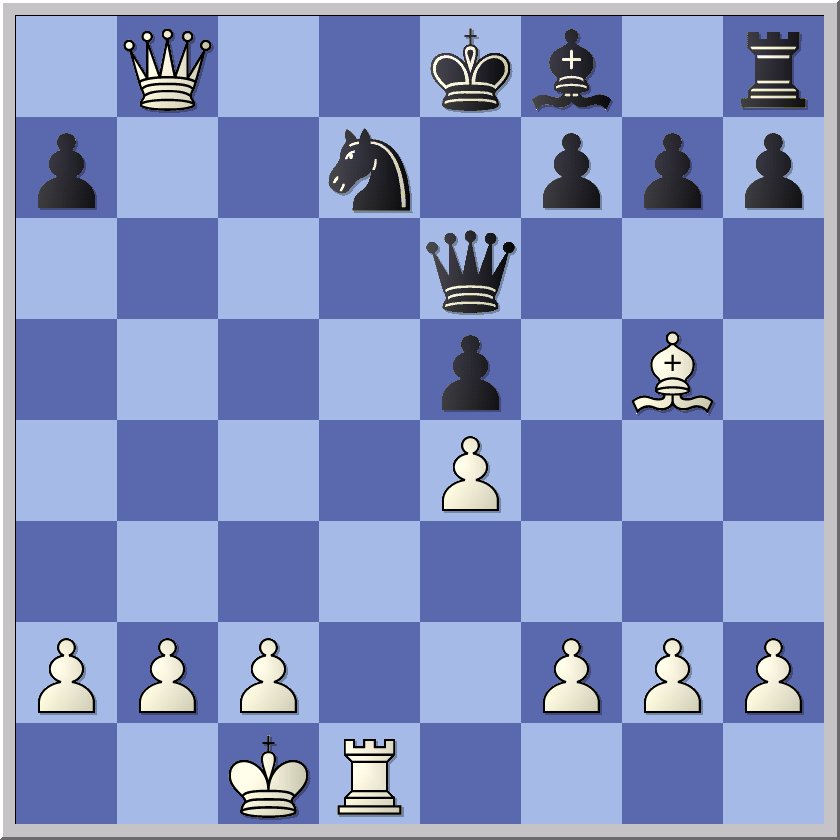
A beautiful queen sacrifice! The knight is decoyed away from d7, where it blocks the d-file.
16...Nxb8 17.Rd8# 1-0
The uncastled king is trapped and checkmated.
What did we learn from this game?
1.Morphy shows how to develop the chess pieces quickly.
2.The Nxb5 sacrifice for 2 pawns. Not only did White get 2 pawns for the knight, the Black king was trapped in the center for the rest of the game.
3.You can sacrifice even your queen, if it leads to checkmate!
10/15/2006
PS116 LESSON ON OCTOBER 10,2006
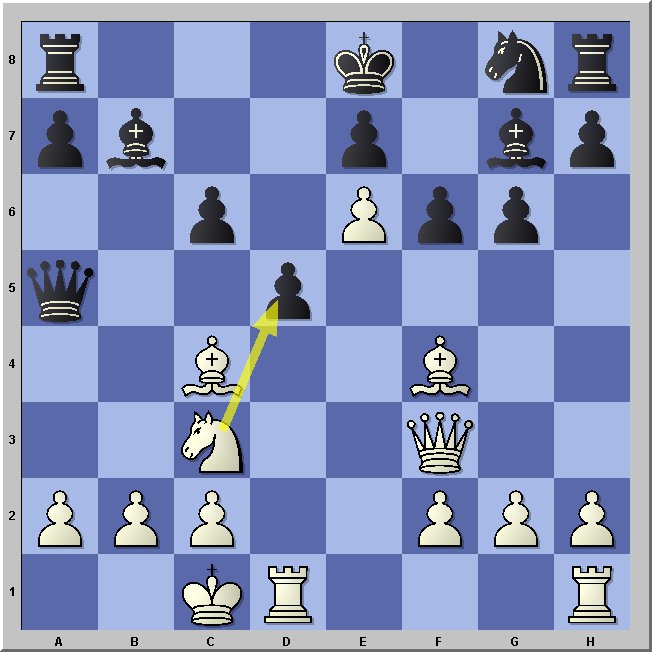 Hello from NyChessKids.
On Thursday we studied back rank. This combination is one of the most important lessons in chess. We anylazied game between Gara Ticia against Konetzke Raphael.
White started game with 1.e4 c5 2. Nf3 Nc6 3. d4 cxd4 4. Nxd4 Nf6 Game began with famous sicilian defense.5.Nc3 g6 6.Nxc6 bxc6 7.e5 Ng8Black got himself into bad position. If you have to move your pieces backwards in the beginning of the game the end is not gonna be very good. 8.Bc4 Bg7 9.Qf3 f6 10. Bf4 Bb7 11.0-0-0 Qa5 12. e6 Nice move. Pawn on e6 is making a lot of troubles for black king. d5 13. Nxd5 black didn't expect this sacrifice. Black king is in the center of the board. that is why white has right to give up his knight and attack. cxd5 14. Bxd5 Bxd5 15. Rxd5 Qa2 16.Ra5 What a great move. Black queen has to accept the challenge.
Qa5 17. Qc6 small trick and black king is trapped on the last rank. Kf8 18.Qa8 Qd8 19. Qd8 checkmate.
---------------------------------------------------------------------
What did we learn from this game:
1. Moving the pieces in the beginning of the game is not recommended.
2.You can sacrifice your stronger pieces if you think opponent's king might be in trouble.
3.white pawn on sixth rank helped us to trap king on last rank.
Good luck with your homework.
Posted by Saudin on October 13,2006
10/13/2006
SPECIAL MUSIC SCHOOL LESSON- October 13,2006
Today we studied game between Centero and Munos Iscua played in Montevideo in 1954.
This game is very instructive for kids for several reasons. We learned about king in the center of the chess board and problems that black king faced on diagonal h5-e8.
How to study this game:
1. Print the game
2. Set up chess pieces
3. Ask your mom or dad to help you move the pieces on the board.
4. Read the text and the most important enjoy.
This game is very instructive for kids for several reasons. We learned about king in the center of the chess board and problems that black king faced on diagonal h5-e8.
How to study this game:
1. Print the game
2. Set up chess pieces
3. Ask your mom or dad to help you move the pieces on the board.
4. Read the text and the most important enjoy.

Game started with 1.e4 d6 2.d4 f5 Of course this is a very dangerous move for black king. It is not recommended to open the king in the beginning of the game.
White continued with 3. Bd3 Nc6 4. exf5 Nd4 5.Qh5 g6 6. fxg6 Nf6 This is the first important position for children to understand. Take few minutes and think what would you play in this position.?
7. g7 Yes, you don't have to run with a queen.If you found this move you probably feel very happy now. Black proudly captured the Queen with 7...Nh5,but white got the new one with 8. gxh8. Of course I hope you know the rule when pawn gets to the other side becomes more important piece. Black played 8...Nf6 9. Bh6 Ne6 10. Bf5 Bd7 Next white move is realy beautiful. take few minutes and think what would you play in this position?
Did you find 11. Qh7 What a great move. Black grabbed the queen very fast with 11..Nh7 What now?
Checkmate 12 Bg6 game over.
What did we learn from this game:
1. Don't open your king. Black move 2...f5 was very dangerous for the black king.
2.It was very dangereous for black king to stay in the center.
3. White was very smart to use diagonal h5-e8
4. The most important moves in this game are 7.g7 and 11. Qh7
Good luck with your homework.
Posted by Saudin Robovic
10/11/2006
SAUDIN'S COLUMBUS DAY WORKSHOP LESSON (ADVANCED GROUP) OCTOBER 9, 2006

During the Columbus Day Workshop on October 9, Saudin presented one of his own games from long ago to the advanced group. Use this for further study.
Saudin Robovic-Franz Winkler, Vienna 1991
A tricky move, preparing to open the h-file for the rook on h1, and preparing a sacrifice...
8...Nc6 9.e5 dxe5 10.dxe5 Nd5 11.Bxh7+

Saudin Robovic-Franz Winkler, Vienna 1991
1.e4 c5
The Sicilian Defense, Black's most popular reply to 1.e4 giving chances for a great fight.
2.Nf3 d6 3.c3 e6
Not the best move. 3...Nf6 would be better because it protects the center and does not allow
Not the best move. 3...Nf6 would be better because it protects the center and does not allow
White to take complete control of it.
4.d4 cxd4 5.cxd4 Be7 6.Nc3 Nf6 7.Bd3 0-0 8.h4
A tricky move, preparing to open the h-file for the rook on h1, and preparing a sacrifice...
8...Nc6 9.e5 dxe5 10.dxe5 Nd5 11.Bxh7+

Now watch what happens. This is an idea to remember!
11...Kxh7
Not taking the bishop would not help.
12.Ng5+ Kg8 13.Qh5 Bxg5 14.hxg5 f5 15.g6
Now the Black King is trapped!
15...Re8 16.Qh8#
__________________________________________________
What did we learn from this lesson?
1.A powerful pawn center gives you freedom of movement for your pieces, and restricts your opponent's pieces.
2.The "Greek Gift" sacrifice with Bxh7+, followed by Ng5+ and Qh5. You need three pieces for this: bishop on b1-h7 diagonal, knight that can jump to g5, and queen on the d1-h5 diagonal. In this case, we needed a support pawn on h4 and rook on h1.
3.Before you sacrifice on h7, you need to do some calculation and be careful that your attack works!
10/06/2006
PS 116 LESSON: ADVANCED CLASS OCTOBER 6, 2006
This lesson was explained on October 6 on the projector by Saudin Robovic.

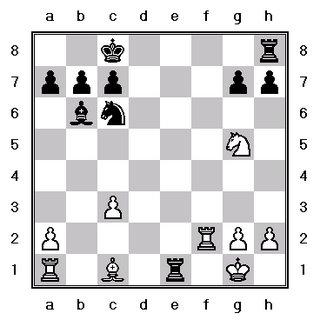
To see this game on your computer, you can go here.
Good luck with your chess studies!
The game was Staunton-Horwitz, London 1846. For homework, study the game.
1.e4 e5 2.Nf3 Nc6 3.d4 exd4 4.Bc4 Bb4 5.c3 dxc3 6.bxc3 Ba5 7.0-0 d6 8.e5 (see Diagram 1)
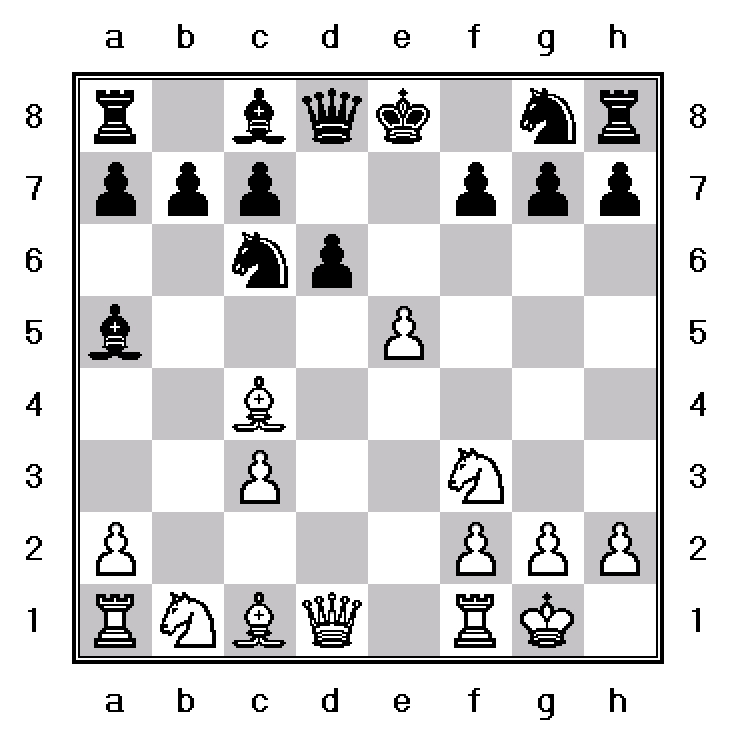
White is threatening to open the e-file and play Re1+. Now Black played 8...Be6, to exchange the powerful White bishop on c4.
9.Bxe6 fxe6 10.exd6 Qxd6
Black captures with the Queen, as he wants to trade pieces, being a pawn up.
11.Qb6 0-0-0 12.Ng5 Rd7 13.Nxe6 Bb6 14.Ng5 Nh6 15.Nd2 Ng4 16.Ndf3
This is a mistake. Better was Ngf3, but then the White queenside pieces have a hard time getting out.
16...Nxf2 17.Rxf2 Qd1+ and White resigned because of 18.Qxd1 Rxd1#.
The b6-bishop pins the f2-rook to the White king, allowing Black this back-rank checkmate.
What did we learn from this game?
1.After 8...Be6, we learn to trade very powerful attacking pieces. Once traded, they can't hurt you anymore!
2.After 10...Qxd6. When you are a pawn up, trade pieces!
3.In the fnial position, White had bank-rank problems. It is important to give your king a little bit of air with h2-h3 or g2-g3 (h7-h6 or g7-g6 if you have Black).
How to study this game for homework:
Set up the pieces on the chessboard, read through the game and play the moves on the board. This will help you learn the game and also practice reading and writing chess notation.
To see this game on your computer, you can go here.
Good luck with your chess studies!
Subscribe to:
Posts (Atom)

